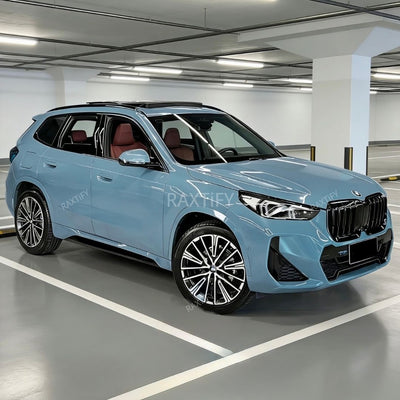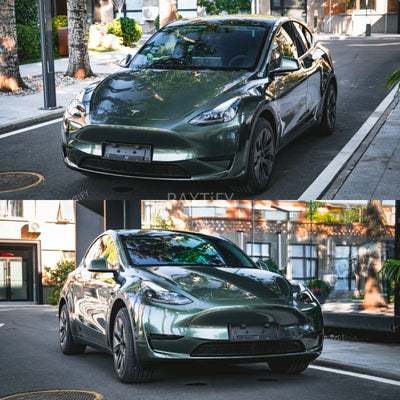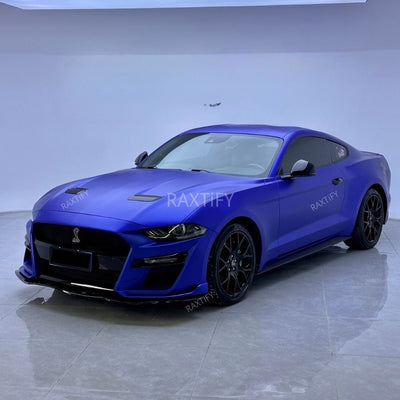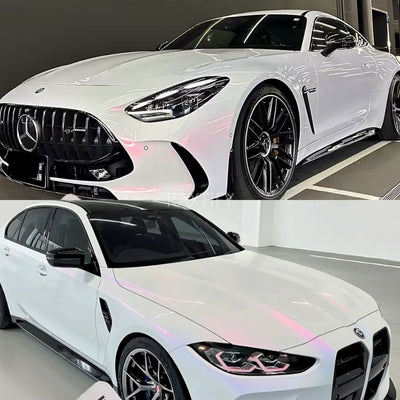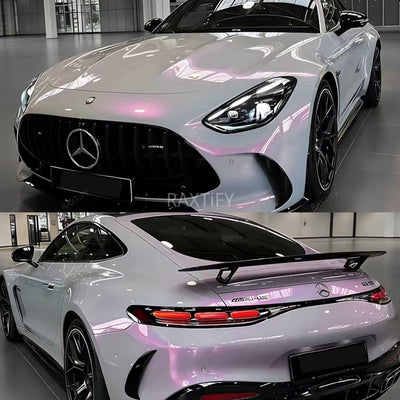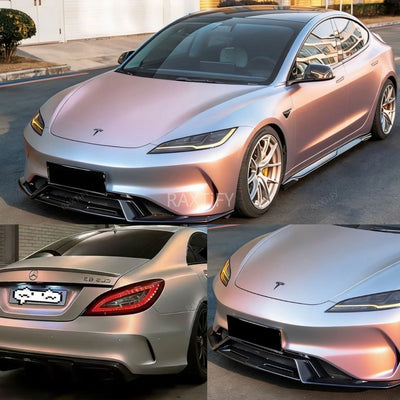

A vinyl wrap is one of the most flexible ways to change a Ford Mustang’s appearance without committing to a permanent repaint. From clean gloss and metallic finishes to satin, color shift, chrome, and custom graphics, the right wrap can completely change the car’s character while remaining removable when properly installed over sound factory paint.

Should You Wrap a Ford Mustang?
For many Mustang owners, wrapping makes sense because the car responds especially well to visual changes. The long hood, pronounced rear quarters, and strong body lines give different finishes plenty of surface area to show depth, reflection, and color movement.
At RAXTiFY, we generally see vinyl wrapping as the better choice when the main goal is color change, personalization, reversibility, or experimenting with a new style without permanently altering the original paint.
Color Change and Personalization
One of the biggest advantages of wrapping a Mustang is the range of styles available.
A factory paint color gives you one look. Vinyl lets you choose from:
- Gloss solid colors
- Gloss metallic finishes
- Satin and matte colors
- Color-shift films
- Chrome and satin chrome
- Pearl and specialty finishes
- Custom printed graphics
- Racing stripes and accent wraps
This flexibility is particularly useful on a Mustang because the same car can look completely different depending on the finish.
A deep gloss metallic color can create a refined OEM-inspired appearance, while satin black gives the car a more aggressive street look. Color shift and chrome finishes work better when maximum visual impact is the goal.
Our advice is to choose the overall look you want first, then choose the exact color. Finish often changes the character of a Mustang just as much as color does.
You can compare more options in our Mustang vinyl wraps collection.
Removability and Factory Paint Considerations
A properly installed automotive vinyl wrap is designed to be removable later.
When applied over healthy, properly cured factory paint and removed correctly, a quality color-change wrap should not damage the original finish. This is one reason many Mustang owners choose vinyl instead of making a permanent color change.
However, the condition of the paint before installation matters.
Vinyl should not be treated as a way to repair:
- Peeling clear coat
- Failing paint
- Rust
- Deep scratches
- Poor-quality repaint work
- Loose body filler
If the underlying surface is already weak, removing the vinyl later may pull on that damaged area.
Before wrapping an older Mustang or a car with previous bodywork, we recommend inspecting the paint carefully first. A wrap will follow the condition of the surface underneath it—it will not hide major defects the way body repair and repainting can.
Vinyl Wrap vs Paint
Vinyl wrap and paint can both change a Mustang’s appearance, but they serve different purposes.
Choose vinyl wrap if you want:
- A reversible color change
- More finish options
- Custom graphics or gradients
- Faster visual transformation
- The ability to return to the original color later
Choose paint if you want:
- A permanent color change
- Body repair at the same time
- Correction of damaged or failing paint
- A finish intended to remain for many years
For most owners who simply want to change the look of a clean Mustang, we usually recommend considering vinyl first.
Paint makes more sense when the vehicle already needs significant bodywork or when the owner wants a permanent refinishing project.
If cost is part of the decision, see our full Mustang wrap cost guide for current professional and DIY pricing.
Best Vinyl Wrap Finishes for a Mustang
The Mustang has strong shoulder lines, a long hood, and wide rear quarters, so the finish you choose can change the character of the car just as much as the color itself. In our experience, Mustangs work particularly well with finishes that emphasize those body lines rather than flatten them completely. If you are still comparing colors and finishes, browse our Mustang vinyl wraps for more options.
Gloss
Gloss vinyl is one of the safest choices for a Mustang, especially if you want a clean, paint-like appearance.

Because gloss film reflects light clearly, it helps preserve the Mustang’s hood shape, door contours, and rear-quarter lines. It also works well across almost every Mustang generation, from older Fox Body and S197 cars to newer S550 and S650 models.
For a daily-driven Mustang, gloss is usually one of the first finishes we recommend because it offers a familiar OEM-style appearance without making the car look overly modified.
Gloss Metallic
Gloss metallic is one of our favorite finishes for a Mustang.

Compared with standard gloss vinyl, the metallic particles add more visual depth when light moves across the hood, fenders, and rear quarters. Dark metallic blue, purple, green, gray, and red finishes can look relatively subtle in shade but become much more dynamic under direct sunlight.
For owners who want something more distinctive than a factory-style solid color without moving into chrome or color shift, gloss metallic is an excellent middle ground.
Satin and Matte
Satin and matte finishes are popular for Mustang builds with a more aggressive or understated style.

Between the two, we generally prefer satin for most daily-driven Mustangs. Satin reduces reflections while still retaining enough sheen to show the vehicle’s body lines. Matte creates a flatter, more stealth-oriented look, but some of the Mustang’s contours can appear less pronounced.
Satin black, dark gray, military green, and muted metallic tones work particularly well on Mustangs with black wheels, spoilers, splitters, and other performance-focused exterior details.
Color Shift
Color-shift vinyl works especially well on Mustangs because the car has large curved surfaces that allow the changing colors to become visible from different angles.

A color-shift finish may appear predominantly blue, purple, green, red, or black from one angle and transition into another color as the lighting changes. The effect tends to be especially noticeable across the doors, rear quarters, and front fenders.
For owners building a show car or simply wanting something less common than a traditional single-color wrap, color shift is one of the most visually dramatic options without going all the way to mirror chrome.
Chrome
Chrome vinyl gives a Mustang a much more aggressive and attention-grabbing appearance.

Mirror chrome creates the strongest reflective effect, while satin chrome offers a softer metallic look that is usually easier to integrate into a street build. On Mustangs, chrome can work particularly well in red, blue, silver, gold, and darker metallic shades.
From an installation standpoint, however, chrome is less forgiving than conventional gloss or satin vinyl. We would not usually recommend a full chrome Mustang as a first DIY wrap project, particularly around the bumpers, mirrors, and complex body contours.
Custom Printed Wraps
A custom printed wrap gives you much more freedom than choosing a single pre-made color.

Mustang owners can use custom graphics, racing-inspired designs, gradients, anime-style artwork, camouflage, sponsor-style graphics, or completely original artwork. The Mustang’s long doors, hood, and rear quarter panels provide plenty of usable space for larger designs.
For custom printed projects, we recommend designing around the actual Mustang generation and body shape rather than applying the same graphic layout to every model. Proper panel alignment is especially important when graphics continue across doors, fenders, or quarter panels.
How Much Vinyl Do You Need to Wrap a Mustang?
Most modern Ford Mustangs require roughly 59 feet of 5-foot-wide vinyl for a carefully planned full exterior wrap. However, we do not recommend treating that number as a guaranteed minimum for every project. Beginners, directional films, complex bumpers, aftermarket body parts, or installation mistakes can all increase material usage.
From our experience, it is better to order a reasonable safety margin than to run short near the end of the installation. Different Mustang generations and body configurations may also require slightly different amounts.
For generation-specific estimates and roll-size recommendations, see our how much vinyl you need to wrap a Mustang guide.
How Much Does It Cost to Wrap a Mustang?
A professional full wrap for a Ford Mustang in the U.S. typically costs around $3,000 to $4,500 for standard gloss, matte, or satin finishes. Specialty films, complex bodywork, chrome, custom graphics, or more demanding installations can increase the price to approximately $4,500 to $6,500 or more.
DIY material costs are considerably lower, typically around $600 to $1,200+, depending on the vinyl finish, roll size, tools, and how much extra material you order.
Actual pricing varies by Mustang generation, vehicle condition, installer labor rates, finish, and modifications. For a full breakdown, see our Mustang wrap cost guide.
Is a Mustang Difficult to Vinyl Wrap?
A Ford Mustang is moderately challenging to vinyl wrap. The large hood, roof, doors, and quarter panels are relatively straightforward compared with many highly sculpted vehicles, but the front and rear bumpers, mirrors, vents, spoilers, and performance aero can require considerably more skill.
From our experience, a Mustang is a reasonable full-car project for someone who already understands basic vinyl handling, but we would not consider the entire car beginner-easy. The difficulty is concentrated in a few complex areas rather than evenly distributed across the vehicle.
Hood, Roof and Doors
The hood, roof, and doors are generally among the easier Mustang panels to wrap because they provide larger, more continuous surfaces.
For these panels, the main priorities are:
- Keeping the film evenly tensioned
- Avoiding unnecessary stretching
- Maintaining consistent film direction
- Leaving enough material around edges for proper finishing
The Mustang's long hood is particularly good at showing metallic, pearl, satin, and color-shift finishes. However, performance hoods with vents or additional contours require more planning than a standard hood.
For directional films, always establish the orientation before cutting. A metallic or color-shift hood installed in the opposite direction from the fenders can appear noticeably different under sunlight.
Front and Rear Bumpers
The bumpers are usually the most difficult parts of a Mustang wrap.
Both ends of the car combine:
- Deep curves
- Air openings
- Recessed areas
- Sharp transitions
- Multiple edges
- Stretch-sensitive corners
This means a bumper can consume relatively little vinyl by surface area but still require significantly more installation time than a door or roof.
One mistake we see inexperienced installers make is trying to force a single piece of vinyl into every recess using excessive stretch. That can create tension around edges and recessed areas, increasing the risk of lifting later.
Our preference is to plan the bumper installation before applying heat and use controlled stretch only where necessary.
Mirrors, Spoilers and Performance Aero
Mirrors look small, but their compound curves can make them surprisingly difficult to wrap cleanly.
Spoilers, splitters, side skirts, hood vents, louvers, and aftermarket aero can also increase installation time because they introduce:
- Additional edges
- Tight curves
- Small recessed areas
- More trimming
- Extra disassembly
This matters especially on modified GT, Mach 1, Shelby, Dark Horse, and other performance-oriented builds.
If your Mustang has aftermarket body parts, do not estimate the installation difficulty based only on the factory model. A Mustang with an aggressive body kit can be substantially harder to wrap than a stock car.
S550 vs S650 Installation Considerations
The S550 Mustang (2015–2023) and S650 Mustang (2024+) are both very workable platforms for vinyl, but we approach their details differently.
The S550 has broad body surfaces that generally make the hood, doors, roof, and large side sections manageable. The main difficulties are concentrated around the bumpers, mirrors, rear contours, vents, and performance aero.
The S650 uses a more angular exterior design with sharper fascia details and more pronounced openings on certain trims. Performance models can also add more aggressive hood, bumper, spoiler, and aero features.
In practical terms, we would not say that every S650 is automatically harder to wrap than every S550. Trim level, body modifications, hood design, spoiler configuration, and aero package often matter more than the generation itself.
If you plan to install the film yourself, our how to vinyl wrap a Mustang guide covers preparation, panel planning, application, trimming, and Mustang-specific installation challenges in more detail.
Real Mustang Wraps From RAXTiFY
Color swatches are useful, but they cannot fully show how a vinyl finish behaves across a Mustang's hood, doors, quarter panels, and body lines. This is why we prefer using real wrapped cars whenever possible when helping customers compare colors.
Here are several Mustang builds that demonstrate how different finishes can change the character of the car.
Matte Chrome Romanee Red Vinyl Wrap
Matte Chrome Romanee Red gives the Mustang a deeper and more aggressive red than a conventional gloss finish. The matte-chrome surface still catches enough light to define the hood, fenders, and rear quarter panels, but without the mirror-like reflection of a full chrome wrap.

On a Mustang, we like this finish because it combines a performance-oriented red with a slightly more refined surface. Under stronger light, the red appears brighter and more dimensional, while in shade it takes on a darker, richer tone.
For owners who want a red Mustang that stands out without looking overly glossy, Romanee Red is one of the more distinctive options we have seen.
Gloss Metallic Mamba Green Vinyl Wrap
Gloss Metallic Mamba Green creates a much bolder appearance. The metallic particles add noticeable depth, particularly across the Mustang's hood and curved rear quarters, while the gloss surface keeps the finish closer to a high-end painted look.

From our experience, darker metallic greens suit the Mustang particularly well because they can look relatively restrained in low light and much more vivid under direct sunlight.
Mamba Green is a strong choice for owners who want something less common than black, gray, or blue while still keeping a relatively sophisticated look.
Gloss Metallic Silver Lake Blue Vinyl Wrap
Gloss Metallic Silver Lake Blue gives the Mustang a cleaner and more refined appearance than many darker performance colors.

The light blue tone makes the body lines easy to see, while the metallic finish adds enough reflection to keep the color from appearing flat. On a Mustang, this works especially well across the doors, hood, and rear fenders, where changing light can make the blue appear brighter or slightly more muted depending on the environment.
We generally recommend colors like Silver Lake Blue to owners who want their Mustang to look noticeably different without moving into an extremely bright or show-oriented finish.
Gloss Metallic Eve Purple Vinyl Wrap
Gloss Metallic Eve Purple brings out a very different side of the Mustang. It is darker and more dramatic than many standard purple wraps, but the metallic surface prevents the color from disappearing into shadow.

On the Mustang's larger panels, the purple develops more depth as the viewing angle changes. The hood and rear quarter panels in particular tend to show the metallic character well because those surfaces catch light from multiple directions.
For owners looking for a more individual build, we consider deep metallic purple one of the strongest matches for the Mustang. It feels aggressive without relying on chrome or extremely bright colors.
You can see additional customer builds, colors, and finishes in our real Mustang wrap gallery.
How Long Does a Mustang Vinyl Wrap Last?
A RAXTiFY vinyl wrap typically lasts around 2–3 years when properly installed and maintained.
The actual lifespan can vary depending on several factors:
- UV and sun exposure
- Climate and temperature
- Outdoor versus garage parking
- Washing frequency and technique
- Vinyl finish
- Installation quality
- How frequently the Mustang is driven
On a Mustang, the hood, roof, trunk, and upper surfaces usually receive the greatest amount of direct sunlight. Cars that spend most of their time outdoors in hot, sunny climates can therefore experience faster fading and surface aging than garage-kept vehicles.
Specialty films such as chrome, satin chrome, matte, and certain color-shift finishes may also require more careful maintenance than conventional gloss vinyl.
From our experience, good wrap care is less about using complicated products and more about consistency: remove contaminants early, wash the car gently, avoid harsh chemicals, and do not allow damaged or lifting edges to remain untreated for long periods.
If your Mustang is wrapped already, see our Mustang wrap care guide for washing, drying, UV exposure, stain removal, and finish-specific maintenance recommendations.
FAQs About Wrapping a Mustang
Is a Mustang Easy to Vinyl Wrap?
We would not classify a full Mustang as an ideal first-time wrap project.
Large areas such as the hood, roof, and doors are relatively manageable, but the front bumper, rear bumper, mirrors, quarter-panel transitions, spoilers, vents, and performance body parts require more planning and stretch control.
If you are installing the film yourself, read our how to vinyl wrap a Mustang guide before cutting the roll.
What Is the Best Vinyl Wrap Finish for a Mustang?
For most street-driven Mustangs, we tend to recommend gloss metallic, gloss, or satin as the safest starting points.
Gloss metallic enhances the Mustang’s body lines while adding depth. Gloss gives a cleaner paint-like appearance, while satin creates a more aggressive low-sheen look.
Color shift and chrome can look excellent on a Mustang, but they create a much more dramatic result and may require more installation experience.
Can You Wrap an Older Mustang?
Yes, but paint condition becomes increasingly important as the vehicle ages.
Older Mustangs may have repainted panels, clear-coat failure, rust repair, body filler, or previous collision work. These areas should be inspected before installation because vinyl adheres best to smooth, stable, properly cured paint.
Do not assume that wrap film will hide or repair poor paint underneath.
Can I Wrap Only Part of My Mustang?
Yes. Partial wrapping is common on Mustangs.
Popular areas include:
- Hood
- Roof
- Trunk
- Mirrors
- Spoiler
- Racing stripes
- Rocker panels
- Accent panels
Partial wraps are a useful option if you want contrast without changing the entire vehicle.
How Long Does a Mustang Vinyl Wrap Last?
RAXTiFY vinyl wraps typically last around 2–3 years with proper installation and care.
Actual lifespan depends on UV exposure, climate, storage, washing habits, vehicle use, and the specific vinyl finish.
A garaged Mustang that is washed carefully will usually age better than one exposed to strong sunlight and harsh weather every day.
For maintenance advice, see our guide on how to care for a Mustang wrap.
Will Vinyl Wrap Damage My Mustang’s Paint?
When installed over healthy factory paint and removed correctly, automotive vinyl wrap should not damage the original finish.
Problems are more likely when the underlying paint is already peeling, poorly repaired, improperly cured, or otherwise unstable.
That is why surface inspection is an important part of any wrap project.
Can I Remove the Wrap and Return the Mustang to Its Original Color?
Yes. One of the main advantages of vinyl is reversibility.
The wrap can be removed later to reveal the original paint underneath, assuming the paint was in good condition before installation and the vinyl is removed correctly.
This makes wrapping particularly useful for owners who want a temporary color change or who may sell the vehicle later.
Final Thoughts
A Ford Mustang is a strong candidate for vinyl wrapping because its shape responds well to both subtle and aggressive finishes.
For a daily-driven Mustang, we generally favor gloss, gloss metallic, or satin because they balance appearance, practicality, and long-term usability. For a more attention-grabbing build, color shift, chrome, custom graphics, and specialty finishes can take the car in a completely different direction.
The most important step is to plan the project as a whole. Choose the finish you want, confirm the condition of the paint, calculate the correct amount of material, understand the installation difficulty, and decide whether DIY or professional installation makes more sense for your car.
If you are still deciding what style suits your Mustang, browsing real Mustang wraps is often more useful than looking at small color swatches alone. Once you have a direction in mind, you can explore our Mustang vinyl wraps and build the project around the look you actually want.